
Signs You Need Dryer Vent Cleaning in West Virginia — Before It Becomes a Fire Hazard
The most reliable signs you need dryer vent cleaning are clothes that come out hot but still damp, a laundry room that feels unusually warm during a cycle, and a dryer that shuts off mid-cycle on thermal override — all warning signals that appear months before the obvious “two cycles to dry” symptom most homeowners wait for. In West Virginia, where two-story homes often route vents through attics to roof terminations, these early indicators frequently go unnoticed until lint buildup has already created a serious fire risk. If you’re seeing any of these patterns, call Nova Air Duct Cleaning West Virginia at (877) 361-9762 — we inspect the full vent run, not just what you can see from the laundry room.
Why West Virginia Homes Hide Dryer Vent Problems Longer Than Most
Our state’s housing stock creates a perfect environment for delayed detection. Charleston’s hilltop neighborhoods, the narrow valleys around Huntington, and the scattered rural properties across the state share a common trait: dryer vents that travel farther and turn more corners than the short through-wall setups common in newer suburban developments elsewhere.
Ronald Sanchez, Owner and Lead Technician at Nova Air Duct Cleaning West Virginia, has spent 14 years tracing these vent runs through attics, crawl spaces, and roof assemblies from the Kanawha Valley to the Eastern Panhandle. He’s found that West Virginia’s older two-story construction — much of it built between 1950 and 1980 with laundry facilities tucked into interior spaces — means the average vent run here exceeds 25 feet with multiple elbows. Every additional foot and every 90-degree turn reduces airflow efficiency and accelerates lint accumulation in ways that aren’t visible from the laundry room.
The climate compounds this. Our humid summers mean damp lint adheres to duct walls more stubbornly than in arid regions. Winter temperature swings cause condensation inside metal venting, creating paste-like blockages that standard lint traps never catch. And our rural and semi-rural properties — think the wooded lots around Summersville or the hillside homes in Fayette County — attract birds, squirrels, and insects to vent terminations year-round.
Here’s what this means practically: by the time you notice a problem, your vent has likely been narrowing for 6–18 months. The signs that follow aren’t random annoyances. They’re a progression, and understanding the sequence helps you catch the issue before the NFPA’s documented risk becomes your reality.
The Early Warning Signs Most Homeowners Miss
Industry guidance tends to focus on the late-stage symptom: “Your clothes take too long to dry.” That’s useful, but it’s also the point where your vent is already 70–90% obstructed. Ronald’s approach — developed across hundreds of West Virginia inspections — is to flag the earlier signals that appear when blockage is still manageable.
Your laundry room heats up during a cycle
A properly venting dryer expels nearly all its heat outdoors. When lint narrows the duct, that heat backs into the room. If your laundry space feels noticeably warmer after a load than it did six months ago, restriction has begun. In Charleston’s older homes with louvered doors or interior laundry closets, this heat has nowhere to go, and homeowners often mistake it for “the dryer working hard” rather than a venting failure.
Clothes are hot to the touch but still damp at cycle end
This is the clearest pre-failure indicator. Your dryer’s heating element is functioning — it’s generating sufficient heat — but moisture isn’t escaping fast enough. The fabrics reach high temperature without achieving dryness. This pattern wastes energy, stresses fabrics, and means your vent’s airflow has dropped below the threshold for effective moisture removal.
The dryer shuts off mid-cycle, especially on longer settings
Modern dryers include thermal override switches that cut power when internal temperature exceeds safe limits. A clogged vent forces the dryer to run hotter. The override is a safety feature, not a malfunction — but it’s a direct response to vent restriction. If you’re restarting loads or finding the drum cool mid-cycle, your vent needs immediate attention.
Your exterior vent damper barely moves when the dryer runs
This is the single most useful check Ronald teaches homeowners. Go outside while your dryer is operating on high heat. The vent termination should show steady, forceful airflow — enough to visibly lift a hinged damper or hold a lightweight flap open. Weak movement, intermittent fluttering, or no movement at all indicates significant blockage upstream. In West Virginia, where roof terminations are common and exterior walls may be inaccessible, this test requires a ladder or binoculars, but it’s worth doing monthly.
The lint trap shows less accumulation than usual
Counterintuitive but telling: when airflow drops, lint doesn’t reach the trap. It deposits in the duct instead. If your trap seems cleaner than it used to, your vent may be doing the collecting.
- Musty or burning odor during or after drying — lint overheating creates distinctive smells before visible smoke
- Visible lint accumulation around the interior vent connection or behind the dryer
- Excessive humidity in the laundry area, sometimes with condensation on windows or walls
- Increased drying time for identical loads — track this with towels or jeans for consistency
The West Virginia-Specific Risks Competitors Don’t Discuss
Generic dryer vent advice assumes a through-wall termination you can see from your patio. That assumption fails for much of our state’s housing.
Roof terminations and invisible blockages
In Huntington’s hillside neighborhoods and Charleston’s multi-level homes, roof terminations are standard. The lint cap or gooseneck sits 20+ feet above ground, invisible and inaccessible for routine checks. Ronald has found caps completely sealed with lint, bird nests, or deteriorated damper flaps that stuck closed — all creating near-total blockage with zero interior warning sign until the dryer failed or the homeowner noticed extended dry times.
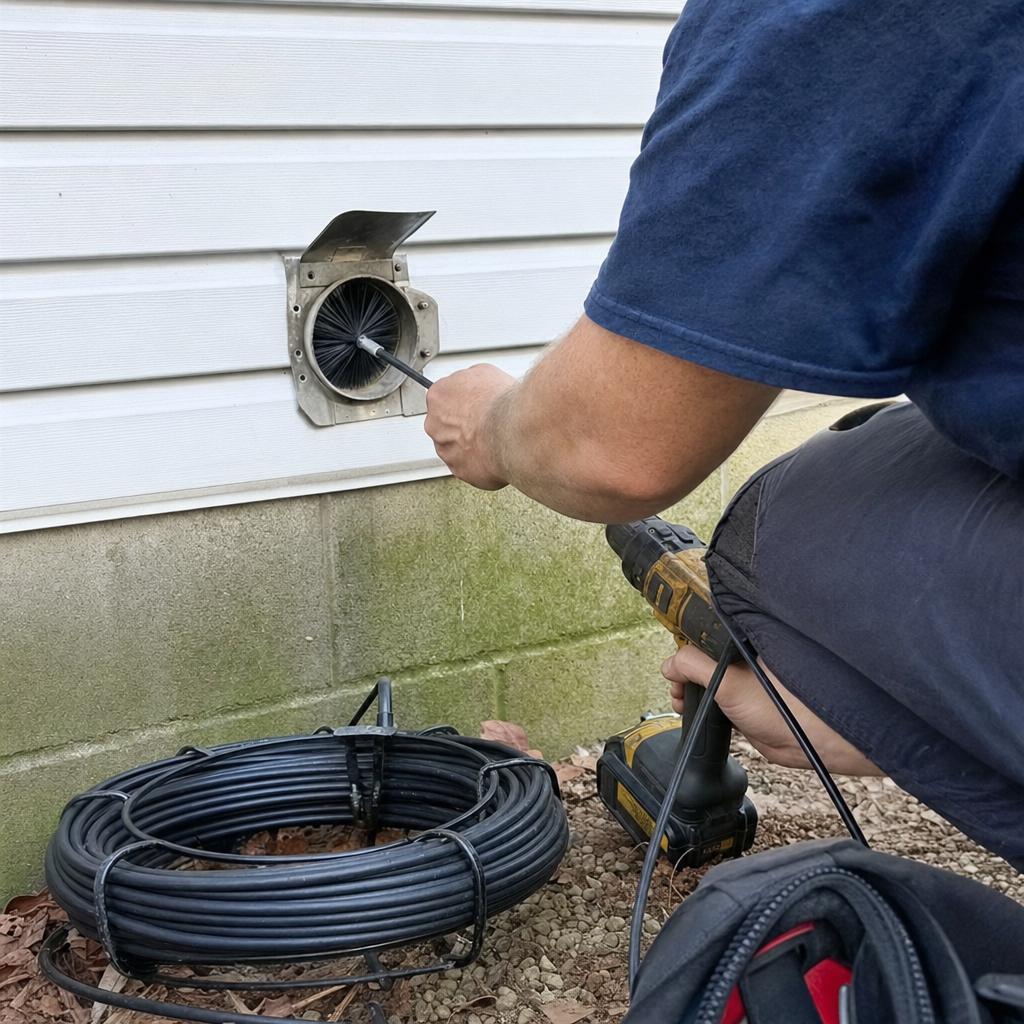
His inspection protocol includes full vent run evaluation: interior connection, duct path through walls or attic, termination type, and exterior airflow measurement. The Rotobrush and Nikro equipment we use on every job handles the extended runs and multiple elbows common in West Virginia construction without the damage risk of improvised tools.
Bird nesting in rural and semi-rural terminations
West Virginia’s wooded lots and agricultural edges attract cavity-nesting species — house sparrows, starlings, and occasionally swallows — that find vent terminations ideal for spring nesting. A nest can reduce vent diameter by 80% in a single season. Unlike lint accumulation, which develops gradually, nesting creates sudden blockage that pushes dryers into thermal override within days.
Ronald inspects terminations for nesting evidence, damaged screens, and improper cap designs during every dryer vent service. Where needed, we install Guardsman vent protection products designed to exclude wildlife without restricting airflow — a specific solution for properties near Coonskin Park’s wooded margins, the Greenbrier Valley’s rural stretches, or any lot with mature tree cover.
Humidity-driven condensation blockages
Our summer humidity averages above 70% for months. When warm, moist dryer exhaust meets cooler duct surfaces in attic runs, condensation forms. Lint becomes paste-like, adheres to duct walls, and builds in layers that standard brushing won’t dislodge. This pattern is particularly common in unconditioned attics — the norm in West Virginia homes built before modern energy codes.
The Nikro negative-pressure vacuum systems we deploy create sufficient airflow to extract this adhered material, combined with rotary brushing that mechanically dislodges without damaging flexible ducting.
What Ignoring These Signs Actually Costs You
The National Fire Protection Association reports approximately 16,000 structure fires annually from clothes dryers or washing machines, with failure to clean as the leading contributing factor. That’s not an abstract statistic — it’s the documented outcome of vents like the ones Ronald inspects weekly.
Beyond fire risk, the operational costs accumulate measurably:
| Condition | Estimated Annual Cost Impact | Typical Timeline to Failure |
|---|---|---|
| Partial blockage (30–50% airflow reduction) | $75–$150 in excess energy | 1–2 years to severe blockage |
| Severe blockage (70%+ reduction) | $200–$400 in excess energy; accelerated wear | 6–12 months to component failure |
| Complete or near-complete obstruction | $400+ energy; thermal fuse/element replacement $150–$300; fire risk | Immediate hazard |
These figures assume standard electric dryer operation in West Virginia’s utility rate environment. Gas dryers add combustion safety considerations — restricted venting can affect burner operation and introduce carbon monoxide concerns that merit immediate professional inspection.
What Professional Dryer Vent Cleaning Includes — and What It Shouldn’t
Ronald’s 14 years in the trade have shown him what separates genuine service from superficial cleaning. A proper job addresses the full system:
- Interior connection inspection: The transition duct behind your dryer — often plastic or foil flex that shouldn’t be there — is checked for damage, proper material, and secure attachment
- Full duct run evaluation: Length, material, elbows, and termination type are documented; inaccessible sections are noted for homeowner awareness
- Mechanical cleaning: Rotary brush systems sized to your duct diameter, with vacuum extraction that captures dislodged debris rather than redistributing it
- Termination service: Cap or damper cleaning, damage assessment, and wildlife exclusion installation where indicated
- Airflow verification: Before-and-after measurement confirming restored performance
What it shouldn’t include: scare tactics about mold or bacteria in dryer vents (wrong environment), upselling to unnecessary services, or a “cleaning” that only brushes the first three feet of duct. Ronald handles your job personally — you’re not getting a subcontractor sent from a dispatch center with a shop vac and a brush kit from the hardware store.
Our Dryer Vent Cleaning service integrates with our full indoor air quality scope. Many West Virginia homeowners who call for dryer vent concerns haven’t had their main air duct system evaluated in years. From cleaning to sealing to sanitizing — one call covers it all, using the same Rotobrush and Nikro systems, the same Honeywell and Aprilaire product integration, and the same direct accountability.
When to Call vs. What You Can Check Yourself
There’s a safe middle ground between neglect and unnecessary service calls. Here’s Ronald’s guidance:
You can safely check: Exterior airflow strength (the damper test), lint trap condition, visible transition duct material and condition behind the dryer, and whether your vent termination cap is intact and opening freely.
Call for professional inspection when: Any early warning sign appears; your vent run exceeds 15 feet or has multiple elbows; the termination is on the roof or otherwise inaccessible; you’ve never had the vent professionally cleaned; or your home is more than 10 years old with unknown maintenance history.
The thermal override shutdown specifically warrants prompt attention — it’s your dryer’s last protective step before dangerous overheating. Don’t reset and restart repeatedly.
Clean ducts aren’t a luxury — they’re just the part of your house you forgot to look at.
FAQs
Professional dryer vent cleaning in West Virginia typically ranges from $120 to $250 for standard residential service, with pricing varying based on vent length, accessibility, and whether the termination requires roof access. Extended runs through multiple floors, rigid ducting that needs disassembly, or wildlife exclusion installation may increase the total. Call (877) 361-9762 for an exact quote — estimates are free, and Ronald will walk through what your specific vent configuration involves.
DIY brush kits cost $20–$40 but rarely clean effectively beyond the first few feet of duct, leave substantial lint in place, and risk damaging flexible ducting or dislodging connections you can’t see or reach. For the typical West Virginia home with a 20+ foot vent run to a roof termination, professional cleaning pays for itself in energy savings within 6–12 months while eliminating fire risk. Call (877) 361-9762 — we’ll show you what you’re actually dealing with before you decide.
Same-day service is frequently available for West Virginia properties within our standard service radius, particularly for calls placed before noon. Emergency scheduling prioritizes situations with active thermal override shutdowns or visible smoke/odor. Call (877) 361-9762 to confirm current availability — Ronald handles scheduling directly, so you’ll know immediately what’s possible.
Annual inspection is prudent for most West Virginia homes; active households with daily laundry use, homes with roof terminations, or properties in wooded areas with wildlife exposure benefit from cleaning every 6–12 months. The NFPA recommends cleaning at minimum annually, but our humidity, extended vent runs, and nesting risk mean local conditions often warrant more frequent attention. Call (877) 361-9762 and we’ll assess your specific configuration and usage pattern.
Ready to Have Your Vent Properly Inspected?
If you’d rather have it looked at, Nova Air Duct Cleaning West Virginia offers a no-pressure assessment in West Virginia — call (877) 361-9762. Ronald will inspect your full vent run personally, explain what he finds without upsell, and handle any cleaning needed with the same Rotobrush and Nikro systems he’s used across 734 customer projects. Over 730 homeowners have reviewed us — see what they found.
Written by Ronald Sanchez, Owner & Lead Technician at Nova Air Duct Cleaning West Virginia, serving West Virginia, WV.