
How Often to Clean Air Ducts in West Virginia: A Realistic Schedule for Local Homes
Most homes in West Virginia need air duct cleaning every 3 to 5 years, but that interval shortens to 2 to 3 years for older homes with crawlspace ductwork, pet owners, or allergy sufferers—and stretches to 5 to 7 years only for newer sealed homes with no pets and no respiratory concerns. If you’re unsure where your home falls, a visual inspection costs far less than a full cleaning and tells you exactly what you’re dealing with. For a no-pressure assessment anywhere in West Virginia, call Nova Air Duct Cleaning West Virginia at (877) 361-9762.

The three-to-five-year rule you’ll find plastered across national websites didn’t come from a crawlspace under a 1975 ranch in Kanawha County, and it certainly wasn’t written by someone who’s pulled apart flex duct after a humid West Virginia July. That generic advice treats Phoenix the same as Parkersburg, ignoring that our state runs heating systems from October through March, deals with summer humidity that tops 80 percent, and holds some of the oldest housing stock in the country. After 14 years of opening up duct systems from Charleston to Morgantown, we’ve learned that “how often” depends on where your ducts live, what they’re made of, and who’s breathing what comes out of them.
Why West Virginia’s Climate and Housing Change the Math
West Virginia presents a specific combination of factors that accelerate how quickly ducts get dirty. The home you bought might have been built in 1962 with galvanized steel trunk lines, or in 2005 with flexible ductboard in a vented crawlspace. Either way, our climate works against clean air in ways that milder, drier states simply don’t experience.
Long heating seasons mean more particulate movement. When your blower runs six months straight, it’s not just moving heated air—it’s circulating everything that settled in your ducts during the off-season. Dust, skin cells, pollen that slipped through windows in September, and whatever your crawlspace contributed over the summer. A furnace in West Virginia accumulates more “run hours” per year than the same unit in Tennessee or North Carolina. More hours means more cycles, more filtration load, and more opportunity for buildup to redistribute through your living space.
Summer humidity promotes biofilm in flex duct. Flexible ductwork, common in homes built from the 1980s onward, has a porous interior surface. When July humidity climbs past 80 percent and your crawlspace isn’t fully encapsulated, that moisture lingers in the duct jacket. We’ve opened flex runs in Huntington homes where the interior felt tacky to the touch—not quite mold, but the biofilm precursor that catches dust and holds it like velcro. Once that coating establishes, standard household dust loads stick where they’d otherwise blow through. The result? A three-year-old system in humid conditions can look like a seven-year-old system somewhere drier.
Crawlspace returns pull in ambient contamination. Many West Virginia homes, especially the ranch and split-level designs common from the 1960s through 1990s, draw return air through joist cavities or ductwork routed through vented crawlspaces. That air path pulls in whatever’s under your floor: rodent droppings, fiberglass degradation from old batt insulation, moisture, and the fine silt that collects in any space with a dirt floor. Even when the supply ducts are clean, a contaminated return side recirculates problems through the whole system.
A West Virginia-Specific Cleaning Interval Framework
Ronald Sanchez, Owner and Lead Technician at Nova Air Duct Cleaning West Virginia, developed this schedule after 14 years of inspecting duct systems across the state. It replaces the generic “every 3–5 years” with profiles that match actual local housing stock.
| Home Profile | Recommended Cleaning Interval | Why the Difference |
|---|---|---|
| Newer home (2000+), sealed slab or basement, no pets, no allergies | 5–7 years | Tighter construction, less infiltration, conditioned space ductwork |
| Older home with crawlspace returns, any age HVAC | 3–4 years | Crawlspace exposure, longer heating run times, potential rodent access |
| Home with pets (shedding breeds) or allergy/asthma sufferers | 2–3 years | Dander accumulation, higher particulate sensitivity |
| Post-renovation (any home type) | Immediate, then reassess | Construction dust bypasses filters, settles in ductwork |
| Visible mold, rodent activity, or water damage | Immediate + source remediation | Health hazard overrides any schedule |
These aren’t arbitrary buckets. We’ve cleaned ducts in a 2018 built home in Bridgeport where the sealed crawlspace and MERV-13 filter kept the system remarkably clean at six years. We’ve also opened crawlspace returns in a 1983 home in Beckley where three years of accumulation looked like a decade elsewhere. The difference is knowable before you commit to service—which is why we offer visual inspections as a standalone option.
Inspection vs. Cleaning: The Check That Saves You Money
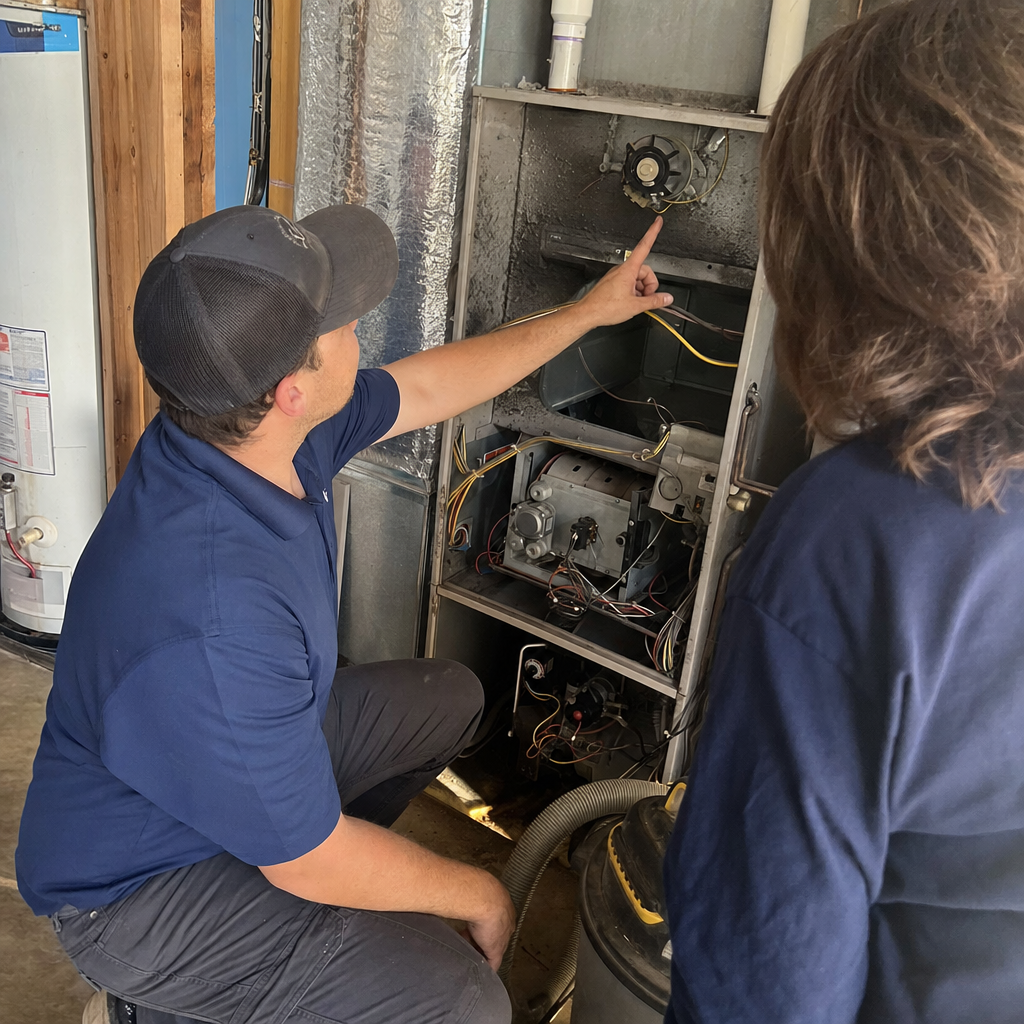
Here’s something the national duct cleaning chains won’t advertise: a proper visual inspection costs less than half a full cleaning, and it tells you whether you actually need the service yet. At Nova Air Duct Cleaning West Virginia, Ronald handles this personally—he’s the one who crawls under your house or feeds the camera through your trunk line.
During an inspection, we’re looking for specific triggers that override any calendar schedule:
- Visible debris at supply registers. If you wipe your finger across a vent and come away with gray buildup, that’s not surface dust—it’s what’s blowing through your system continuously.
- Musty odor on first heat-up. That “basement smell” when the furnace first fires in October? Often microbial growth in the ductwork that activated when summer humidity met winter warmth.
- Allergy symptoms that worsened after moving in. New homeowners frequently inherit a decade of previous owners’ neglect. We’ve had Charleston West Side clients call us six months after closing, mystified by respiratory issues that cleared after their first cleaning.
- Any rodent sign in the home. Droppings in the utility room, gnawed insulation, or that particular ammonia sharpness in the air. Mice and rats use duct systems as highways; their contamination requires immediate professional handling.
- Uneven heating or weak airflow at distant registers. Sometimes blockage, sometimes disconnected ductwork in a crawlspace—either way, inspection finds it before you’re heating your crawlspace instead of your bedroom.
The inspection takes about 45 minutes. We use a borescope camera where access allows, and Ronald will show you what he’s seeing in real time. If the system’s clean, he’ll tell you that straight—schedule pushed back two years, no charge for the honesty. Clean ducts aren’t a luxury — they’re just the part of your house you forgot to look at.
What a 3-Year System Looks Like vs. a 7-Year System in West Virginia
After 14 years and hundreds of West Virginia homes, we can describe the progression with specificity that no generic schedule offers.
At three years in a typical crawlspace-return home: the supply trunk shows a light coating of gray dust, maybe 1/16 inch on horizontal surfaces. The flex duct runs are still mostly clean internally, though the connection boots may show dust tracking where seals have loosened. Return ducts have more accumulation—thicker, darker, often with fiberglass fragments if the original duct liner is degrading. Filters have been doing their job, but bypass around poorly fitted racks has allowed some loading. This system doesn’t yet show performance loss, but it’s entering the zone where cleaning prevents the next stage.
At seven years without cleaning in the same home type: the supply trunk has measurable buildup, often 1/4 inch or more on lower surfaces where dust settles between blower cycles. Flex duct interiors show the tacky biofilm layer that holds particles permanently—this doesn’t brush out with a standard vacuum, requiring rotary mechanical agitation with our Rotobrush system. Return ducts may show staining from water intrusion events the homeowner never knew about. The blower wheel itself is likely loaded, reducing airflow and making the system work harder for the same heat output. At this stage, we almost always find that the homeowner has been running the system longer to feel warm, paying extra on utility bills for months or years.
The Air Duct Cleaning in West Virginia page details our full process, but the key point is this: catching a system at year three costs less and delivers more benefit than waiting until year seven, when accumulated loading has stressed components beyond what cleaning alone can restore.
Equipment That Matches West Virginia’s Duct Challenges
Not all duct cleaning is equal, and not all equipment handles our state’s specific duct configurations. Many West Virginia homes have mixed systems—galvanized steel trunks from original construction, with flex duct additions from later HVAC upgrades. That combination requires adaptable equipment.
We run Rotobrush rotary brush systems on the flex duct portions, where mechanical agitation breaks the biofilm bond that vacuum alone won’t touch. On steel trunk lines and main returns, we use Nikro negative-pressure vacuum systems that extract dislodged debris without redistributing it through your home. For homes with significant microbial concern, we integrate Abatement Technologies HEPA filtration and air scrubbing to capture what the main vacuum might miss.
This matters because the wrong equipment on the wrong duct type can damage your system or leave significant contamination behind. Ronald selects the approach after inspection, not before—another reason the owner-operator model delivers different results than a franchise crew running the same protocol on every house.
When the Calendar Doesn’t Matter: Immediate-Cleaning Triggers
Certain conditions make any schedule irrelevant. If you’re experiencing any of the following, don’t wait for your next planned interval:
- Post-renovation. Construction dust is finer and more abrasive than household dust. Drywall compound, sawdust, and insulation fragments bypass standard filters and embed in duct lining. We recommend cleaning within 30 days of substantial renovation completion.
- Water intrusion or flooding. Any ductwork that has been wet requires immediate inspection and likely cleaning or replacement. Mold establishes within 48-72 hours in our humidity.
- Confirmed rodent presence. Mouse and rat droppings carry pathogens that become airborne when disturbed. This is not a DIY situation—professional containment and HEPA extraction are required.
- New home purchase with unknown maintenance history. If the previous owner can’t tell you when ducts were last cleaned, assume they weren’t. We’ve found systems in South Hills Charleston homes that hadn’t been opened in 20 years.
FAQs
Most residential air duct cleaning jobs in West Virginia range from $300 to $600 for a standard single-system home, with larger homes or systems with significant contamination running higher. The exact price depends on your home’s square footage, number of vents, duct accessibility, and whether we find conditions that require additional attention like mold remediation or rodent decontamination. We provide upfront pricing after inspection—no surprises, no pressure. Call (877) 361-9762 for a free estimate specific to your home.
Repair is almost always cheaper than full replacement for isolated damage—sealing disconnected boots, patching small holes, or reinforcing sagging flex runs typically runs $150 to $400 per issue, while full duct replacement starts around $2,500. However, if your duct system is original to a 1960s or 1970s home and showing widespread degradation, replacement may be the more cost-effective long-term solution. Ronald assesses this honestly during inspection; we’ve saved Beckley homeowners money by repairing sections that another company wanted to replace entirely. Call (877) 361-9762 to have your specific situation evaluated.
We typically schedule inspections within 24 to 48 hours and can often perform cleaning the same day as inspection if the condition warrants it and your schedule allows. Emergency situations—confirmed rodent contamination, post-flooding, or severe allergy flare-ups—get priority scheduling. Same-day service depends on current workload and your location within our West Virginia service area. Call (877) 361-9762 to check availability; we’ll tell you honestly if we can get there today or if tomorrow works better.
If you haven’t had your ducts assessed in more than three years and your home has any of the risk factors we discussed—crawlspace returns, pets, older construction, or recent renovations—start with an inspection. It’s the lower-cost way to get a definitive answer. If you’re already seeing visible debris at registers, smelling musty odors when the heat kicks on, or experiencing unexplained respiratory symptoms, those are active indicators that cleaning is likely needed regardless of calendar timing. Over 730 homeowners have reviewed our inspection process—see what they found. Either way, call (877) 361-9762 and we’ll recommend the right first step for your situation.
If you’d rather have it looked at, Nova Air Duct Cleaning West Virginia offers a no-pressure assessment anywhere in West Virginia—Ronald handles your job personally, you’re not getting a subcontractor, and you’ll get a straight answer about whether your ducts need attention now or can wait. Call (877) 361-9762 for a free estimate.
Written by Ronald Sanchez, Owner & Lead Technician at Nova Air Duct Cleaning West Virginia, serving West Virginia, WV.