
Duct Sealing Cost in West Virginia: What You’ll Actually Pay in 2024
Duct sealing in West Virginia typically runs $450–$1,800 for most homes, depending on whether you need hand-applied mastic sealing or full-system Aeroseal injection. Mastic work on accessible joints averages $3–$8 per linear foot, while Aeroseal runs $1,200–$2,500 for a complete residential system. Call (877) 361-9762 for a free, exact quote — Ronald Sanchez, our owner and lead technician, inspects every system personally before pricing.
Here’s something we see constantly in Charleston’s West Side and South Hills neighborhoods: a homeowner gets one quote for duct sealing, thinks they understand the price, and doesn’t realize they’re looking at an entirely different service than what another company quoted. The numbers aren’t comparable because the methods aren’t comparable. After 14 years crawling through West Virginia crawlspaces and attics, we’ve learned that honesty about what you’re actually buying matters more than a low headline number.
Why West Virginia’s Heating Season Makes Duct Leaks Expensive
West Virginia homes run heat five to six months annually — longer than Virginia to our east, shorter than Ohio to our north, but with more temperature swing than either. Every degree of heated air that leaks into your crawlspace or attic before reaching your living room is air your furnace worked for and you paid for. The Department of Energy estimates 20–30% of conditioned air escapes through duct leaks in typical homes; in older West Virginia housing stock with galvanized ductwork or fiberglass flex runs, we’ve measured losses above 35%.
That leakage hits harder here than in milder climates. A Kentucky homeowner might run heat three months and tolerate some loss. In Kanawha County, where January nights routinely drop below 20°F and February can hold in the teens, leaky ducts mean your furnace cycles longer, your heat pump’s auxiliary strips kick on more often, and your bills climb through December, January, and March. The payback timeline for proper sealing shortens considerably — often two to three heating seasons rather than four or five.
We’ve worked in 1920s Charleston foursquares with original floor furnaces converted to forced air, 1960s ranch homes in St. Albans with metal duct buried in uninsulated crawlspaces, and newer builds in Teays Valley where flex duct was installed fast and sealed poorly. Each has different leakage patterns, different access challenges, and different appropriate fixes.
Mastic Sealing vs. Aeroseal: Two Methods, Two Price Points
This distinction is where most homeowners get confused, and where some contractors benefit from that confusion.
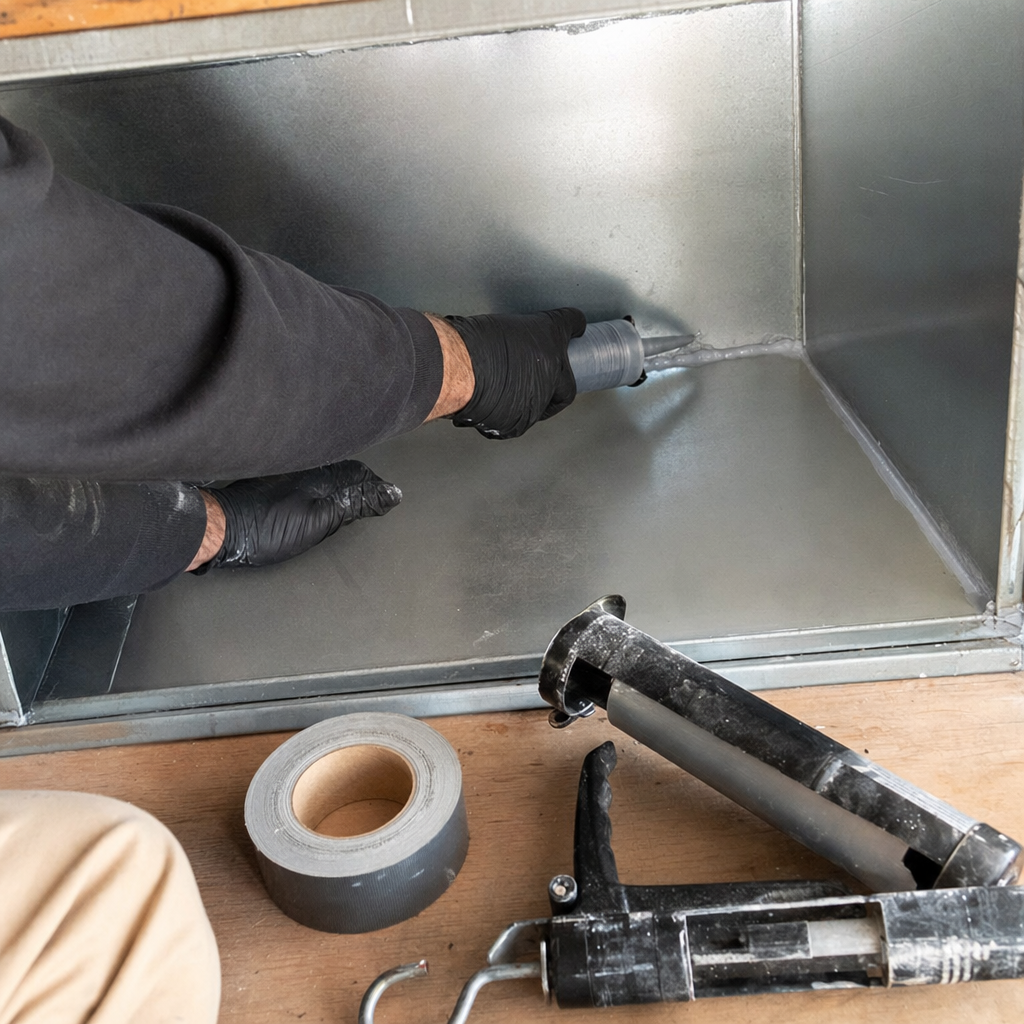
Mastic sealant is a thick, brush-applied paste we hand-work onto every accessible joint, seam, and connection. It’s the traditional method, it works when you can reach the leak, and it’s what most West Virginia homeowners actually need if their ductwork is reasonably accessible. We use Guardsman-brand mastic on our mastic jobs — it’s formulated for the temperature swings our region sees and stays flexible where cheaper compounds crack.
Aeroseal is a different technology entirely. We block your registers, pressurize the duct system, and inject a vinyl polymer fog that seals leaks from the inside — including ones we couldn’t reach with a brush. The computer generates a before-and-after leakage report. It’s impressive technology, genuinely useful for certain situations, and costs significantly more.
When Mastic Sealing Is the Right Choice
- Your ductwork is in an accessible crawlspace or basement with reasonable headroom
- You’re seeing localized issues — one cold room, one weak register — suggesting specific joint failures
- Your ducts were previously sealed but mastic has aged or cracked, especially at takeoff collars
- You’re combining sealing with Duct Repair & Sealing work on damaged sections
- Budget matters and you need meaningful improvement without the Aeroseal premium
When Aeroseal Makes Sense
Aeroseal becomes worth considering when your ducts run through finished walls, buried in insulation, or through tight attic spaces where hand-sealing every joint would require significant demolition. It’s also appropriate when previous mastic work hasn’t solved the problem — sometimes the leaks are in the duct body itself, not the joints. We’ve used it successfully in multi-story homes in Huntington’s historic district where ductwork was retrofitted through walls with no access panels.
What Duct Sealing Costs in West Virginia: Price Breakdown
These ranges reflect what we’ve quoted across our 14 years in the field, from Parkersburg to Beckley. Your exact price depends on system size, access difficulty, and whether we’re addressing a specific problem zone or the full system.
| Service | Typical Range | What Affects Price |
|---|---|---|
| Mastic sealing — per linear foot of duct | $3 – $8 | Duct size, access difficulty, number of joints |
| Mastic sealing — single zone (typical room addition or problem area) | $350 – $650 | Crawlspace depth, presence of moisture barriers, existing damage |
| Mastic sealing — full residential system | $650 – $1,400 | Home size, duct layout complexity, number of returns |
| Aeroseal — full residential system | $1,200 – $2,500 | System leakage rate, home size, register count |
| Combined cleaning + sealing package | $850 – $1,800 | System condition, contamination level, access issues |
Three factors push prices toward the high end in West Virginia specifically:
Crawlspace access. Many homes in the Kanawha Valley and Ohio River corridor sit on damp, tight crawlspaces — 18 inches of clearance, mud, active springs. We seal what we can reach, but some runs require temporary access improvement or simply take longer per joint.
Attic duct in summer. West Virginia attics hit 140°F in July. Ductwork installed there without proper insulation or sealing is a double problem — losing heated air in winter and gaining attic heat in summer. Sealing attic runs often requires early-morning scheduling and involves more protective gear, adding labor time.
Number of problem joints. The takeoff collars where round branch ducts meet the main trunk, flexible duct connections at boots, and return-air plenum seams are the three failure points we find most often in homes built before 1990. A system with fifteen failed joints takes longer than one with five, even if total duct length is identical.
What We Find in West Virginia Ductwork: A Technician’s View
Ronald Sanchez, our owner and lead technician, grew up in Charleston’s West Side and trained at Bridgemont Community and Technical College before spending the last 14 years building Nova Air Duct Cleaning. He’s the one who’ll be in your crawlspace, and he’s seen patterns specific to our region.
In older Charleston homes — the 1910s through 1940s stock in the East End and South Hills — we regularly find galvanized steel duct with original asbestos tape at the seams. The tape degrades, the seams leak, and homeowners wonder why their 90,000 BTU furnace can’t keep a 1,200-square-foot house warm. We remove degraded tape, clean the seam, and apply fresh mastic. It’s not glamorous work, but it’s precise work, and Ronald does it personally rather than sending a crew you haven’t met.
In 1960s and 70s ranches from St. Albans to Nitro, flex duct was installed with zip ties and no mastic at the boots. The flex itself is often intact, but every connection point leaks. These are straightforward fixes if you can reach them — and frustrating if you can’t, which is where Aeroseal becomes worth discussing.
Newer construction isn’t immune. We’ve found unsealed return-air boots in Teays Valley homes less than ten years old, and ductwork in Hurricane subdivisions where the HVAC contractor apparently considered tape sufficient. Tape fails. Mastic doesn’t, when applied correctly.
Our Rotobrush and Nikro equipment lets us clean thoroughly before sealing — sealing dirty ducts just traps contamination. That’s why our combined service matters: one visit, one technician you know, equipment purpose-built for this exact sequence.
The ROI Math for West Virginia Homeowners
We don’t promise specific dollar savings because every home differs, but we can share what we’ve observed. A typical 2,000-square-foot West Virginia home with 25% duct leakage and a heat pump system might see winter electric bills drop 15–25% after comprehensive sealing, based on customer feedback over multiple heating seasons. With propane or natural gas furnaces, the percentage varies with fuel price, but the comfort improvement is consistent — rooms that were cold spots become usable space.
At $800 for full mastic sealing, a 20% reduction on a $200 monthly winter heating bill pays back in roughly two seasons. If you’re on propane and seeing $400+ months, payback accelerates. The calculation favors sealing more strongly here than in climates where heat runs three months and mild weather covers the gaps.
Aeroseal at $1,800 extends payback but solves problems mastic can’t. The right choice depends on what we find during inspection — which is why we don’t quote Aeroseal without looking first, and why we’ll tell you honestly if mastic is sufficient.
How Nova’s Process Works
When you call (877) 361-9762, you’re talking to our scheduling line, but Ronald handles every site visit personally. Here’s what happens:
- Inspection first. We pressurize your duct system and use smoke pencils or theatrical fog to locate leaks — no guesswork, no selling you sealing you don’t need.
- Photo documentation. You’ll see what we found: the corroded takeoff collar, the disconnected flex, the gap where the return plenum meets the air handler.
- Method recommendation. We’ll explain whether mastic, Aeroseal, or a hybrid approach fits your situation, with exact pricing before work begins.
- Single-visit completion. For most mastic jobs, we clean and seal same-day. For Aeroseal, we schedule when the equipment is available — typically within a week.
- Post-work verification. We retest pressure and leakage to confirm improvement. For Aeroseal, you receive the computer-generated report.
Clean ducts aren’t a luxury — they’re just the part of your house you forgot to look at. Sealing them is the logical next step once they’re clean and accessible.
FAQs
Most homeowners pay $450–$1,800, with mastic hand-sealing at $3–$8 per linear foot and full-system Aeroseal running $1,200–$2,500. The exact price depends on your home’s duct layout, access difficulty, and whether we’re targeting specific leaks or the full system. Call (877) 361-9762 for a free inspection and exact quote — estimates are free.
Sealing existing ductwork is almost always cheaper than replacement, which runs $2,000–$5,000+ for full residential systems in West Virginia. Replacement only becomes necessary when ducts are physically damaged, corroded through, or improperly sized for the heating load. During inspection, we’ll show you which category your system falls into — we’ve saved many homeowners thousands by sealing rather than replacing.
Most mastic sealing jobs on accessible ductwork finish in 4–6 hours, and we typically complete them same-day after inspection. Aeroseal requires 2–3 hours of preparation, pressurization, and cure time, so we schedule those as dedicated appointments. Ronald handles the work personally, so scheduling depends on his availability — usually within a few days for standard jobs, faster for urgent situations.
Yes, though the amount varies. West Virginia’s extended heating season means duct leaks cost more here than in milder climates — typically 15–25% winter savings for homes with significant leakage, based on customer feedback we’ve collected over 14 years. The comfort improvement is often more immediate than the bill reduction: rooms that never warmed properly become consistently comfortable. Call (877) 361-9762 and we’ll inspect your system to estimate your specific situation.
Get Your Exact Duct Sealing Quote in West Virginia
Stop guessing at your duct sealing cost based on national averages that don’t account for West Virginia’s heating demands, crawlspace access challenges, or the condition of older regional housing stock. Call (877) 361-9762 to schedule a free inspection with Ronald Sanchez, owner and lead technician. He’ll show you exactly where your system leaks, recommend the right sealing method for your situation, and give you upfront pricing with no pressure. From cleaning to sealing to sanitizing — one call covers it all.
Written by Ronald Sanchez, Owner & Lead Technician at Nova Air Duct Cleaning West Virginia, serving West Virginia, WV.