
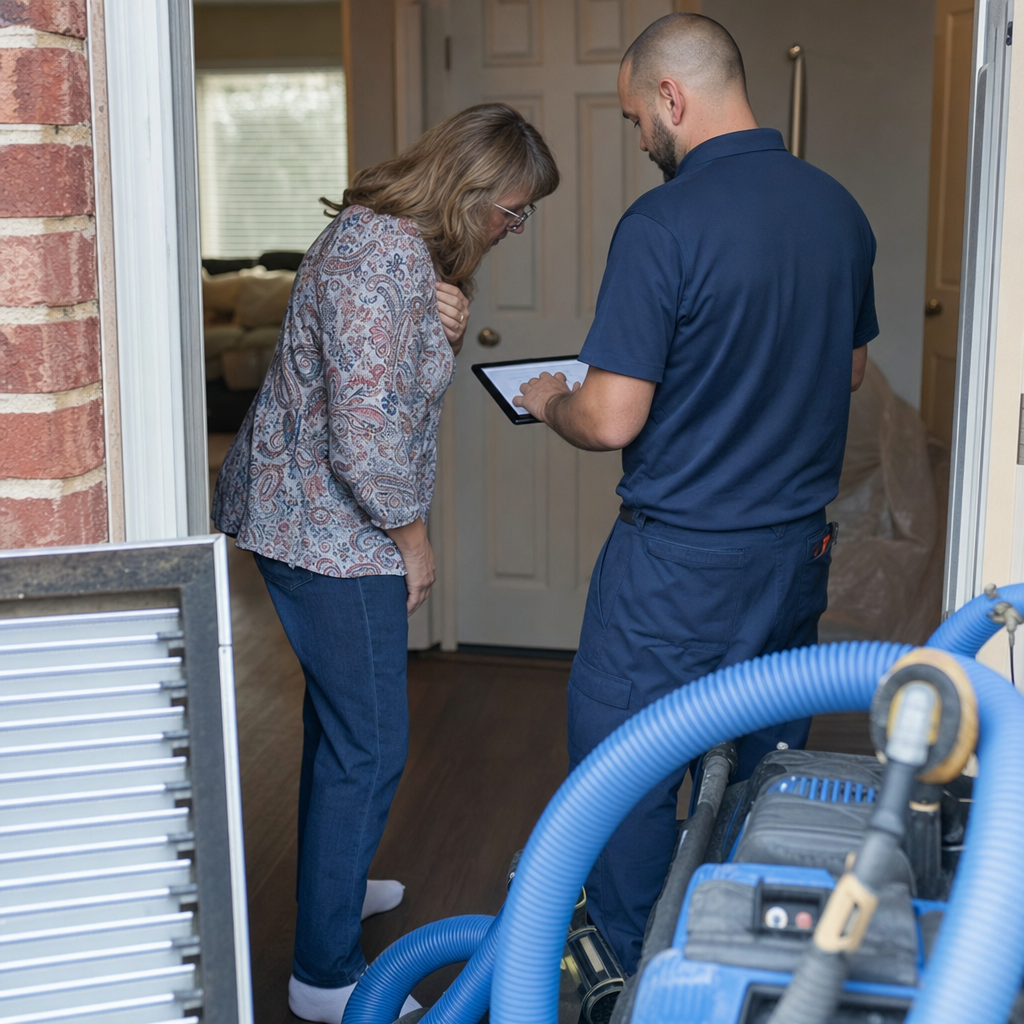
Dryer Vent Cleaning Cost in West Virginia: What You’ll Actually Pay Based on Your Home’s Vent Run
Dryer vent cleaning in West Virginia typically costs between $149 and $395, with most homeowners in the state paying around $225 for a thorough, professional job. The exact price depends on how long your vent run is, how many turns it takes, and whether it exits through a side wall or the roof. For a straight quote on your specific setup, call Nova Air Duct Cleaning West Virginia at (877) 361-9762 — we offer free estimates and same-week scheduling across the state.
Last October, Ronald pulled a bird’s nest the size of a football from a dryer vent in a 1920s Charleston four-square. The vent ran 34 feet from the second-floor laundry closet, dropped through a balloon-framed wall, made two 90-degree bends, and terminated at a roof jack that hadn’t been opened in fifteen years. The job took three hours and required pulling a section of soffit to access a crushed transition duct. A ranch home in Teays Valley we serviced the same week had a six-foot straight run through a rim joist — in and out in forty minutes. Same service, same day, vastly different work. That’s the reality of dryer vent cleaning cost in West Virginia, and it’s why we don’t quote flat rates over the phone without asking about your setup first.
Why West Virginia Homes Drive Higher Dryer Vent Cleaning Costs Than the National Average
West Virginia’s housing stock skews older and more vertically complex than most states, and that directly impacts what you’ll pay for dryer vent service. The home we work on most often was built before 1990, with laundry areas tucked into basements, second-floor closets, or converted porches — nowhere near an exterior wall.
The National Fire Protection Association (NFPA) recommends dryer vents not exceed 25 feet in total length, with each 90-degree elbow subtracting an additional 5 feet from that maximum. In practice, we regularly encounter West Virginia homes with vent runs of 30 to 40 feet, sometimes more. A longer run doesn’t just cost more to clean — it accumulates lint faster, creates more friction that traps debris, and increases fire risk substantially. The U.S. Fire Administration reports that failure to clean dryer vents is the leading cause of home clothes dryer fires, and West Virginia’s older housing inventory puts our state at elevated risk.
Here are the specific factors that move your quote up or down:
- Linear footage of rigid duct: Every additional 10 feet of duct adds brushing time and requires more careful debris extraction with our Nikro negative-pressure system.
- Number and type of elbows: Two 90-degree turns are standard; three or more, or the use of adjustable elbows rather than long-radius sweeps, complicates cleaning and inspection.
- Termination point: Side-wall exits at ground level are simplest. Roof terminations require ladder work and often reveal deteriorated flashing or stuck backdraft dampers that need addressing.
- Access difficulty: Crawlspace runs, soffit enclosures, or ducts buried in finished basement ceilings add labor time.
- Flex duct presence: Crushed or sagging foil transition ducts behind the dryer must be replaced with rigid metal — a material cost we flag before starting work.
- Blockage severity: Bird nests, particularly in rural and semi-rural West Virginia properties near wooded areas, can require partial disassembly and specialized extraction tools.
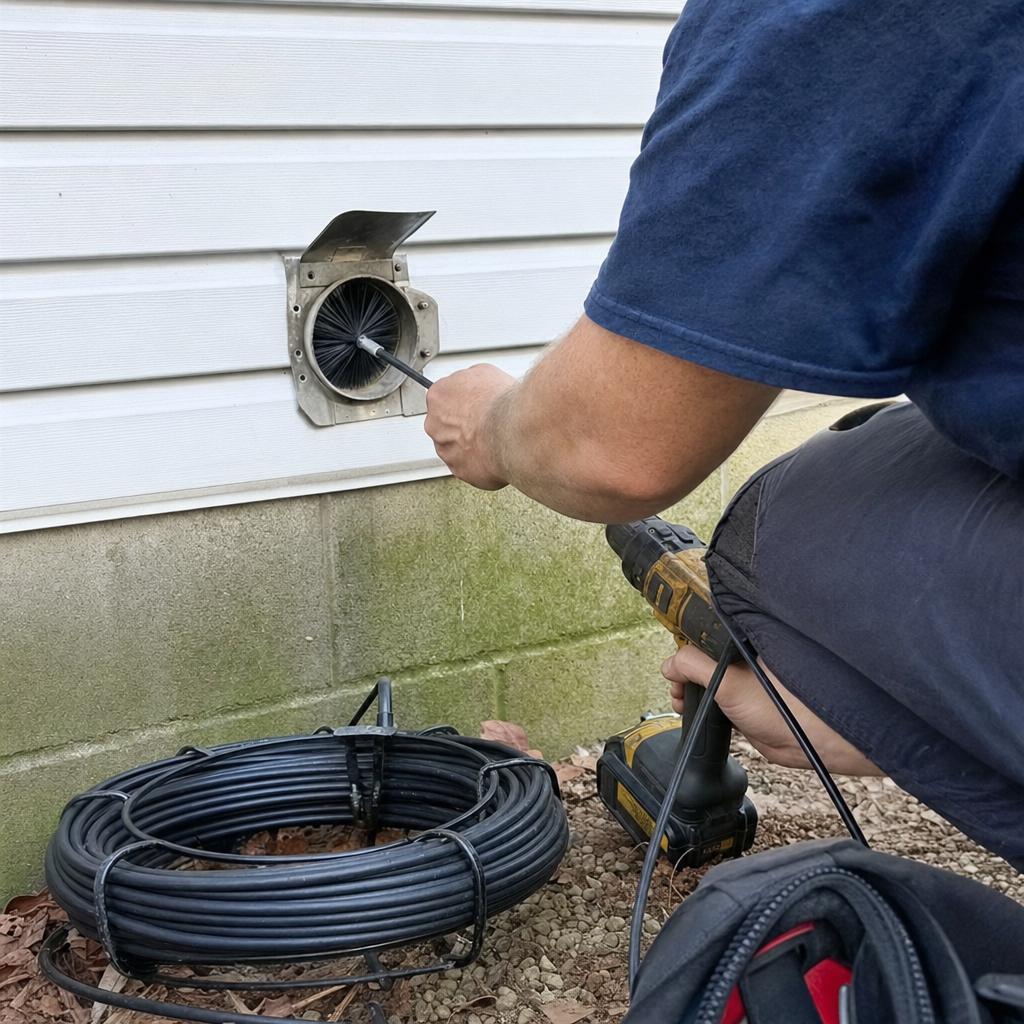
We use Rotobrush rotary brush systems with integrated vacuum on every job, but the technique varies significantly based on these factors. A short, straight run gets a single-pass brush-and-extract. A complex run needs sectional cleaning, reverse airflow verification, and combustion gas backdraft testing at completion — steps that take time but prevent the call-back we see from cut-rate services that blow compressed air through and call it done.
West Virginia Dryer Vent Cleaning Price Breakdown
The table below reflects what Nova Air Duct Cleaning West Virginia actually charges for residential dryer vent service. These are real ranges, not teaser rates designed to get our foot in the door. We’ve built these prices over 14 years of tracking job times and material costs across the state.
| Service Component | Price Range |
|---|---|
| Standard dryer vent cleaning (straight run, ≤15 ft, 1-2 elbows, side-wall termination) | $149 – $195 |
| Extended run cleaning (16-30 ft, multiple elbows, or roof termination) | $195 – $295 |
| Complex/accessible-only run (>30 ft, crawlspace or soffit access required, 3+ elbows) | $295 – $395 |
| Transition duct replacement (rigid metal, includes labor) | $45 – $85 |
| Backdraft damper repair or replacement | $65 – $125 |
| Bird nest or major blockage removal (additional labor) | $75 – $150 |
| Dryer vent inspection only (no cleaning, with written report) | $95 – $125 |
Most West Virginia homeowners fall into the $195-$295 bracket because of vent run length. If you’re in a post-2000 build with a dedicated laundry room on an exterior wall, you’ll likely land at the lower end. If you’re in a converted Charleston Victorian with a basement laundry and roof termination, expect the upper range. We’ll tell you where you sit before we start work — no surprises.
What Separates a Proper Dryer Vent Cleaning From a Brush-and-Blow Special
The lowest-priced dryer vent service you’ll find in West Virginia — often advertised around $89 — typically involves a technician with a leaf blower and a brush kit from a hardware store. They’ll clear the first few feet of visible duct, maybe vacuum behind your dryer, and leave. We’ve been called after these jobs to find the middle and terminal sections packed solid with compressed lint that the blower actually wedged tighter.
Our process, which Ronald performs personally on every Dryer Vent Cleaning job, includes:
- Full visual inspection of the transition duct, exterior termination, and accessible rigid duct sections
- Rotary brush agitation with simultaneous negative-pressure extraction using Nikro equipment — debris comes out, not further in
- Airflow velocity measurement before and after cleaning (we’re looking for 1,000+ FPM at termination for gas dryers)
- Backdraft damper function check — stuck or missing dampers let cold air, humidity, and pests into your duct
- Combustion appliance zone testing when applicable, particularly important for gas dryers in older West Virginia homes with marginal ventilation
- Written condition report with photos if we find damage or code violations
The equipment matters. Rotobrush systems are purpose-built for duct cleaning — flexible shafts that navigate elbows without damaging duct walls, brushes sized to the duct diameter, and integrated vacuum that captures debris at the point of dislodgment. Nikro negative-pressure machines maintain consistent suction even on long runs. This isn’t gear you pick up at a big-box store; it’s what commercial contractors use, scaled for residential application.
We also integrate Dryer Vent Cleaning in West Virginia with our broader air quality services. If Ronald’s already at your home for duct cleaning or HVAC maintenance, he can assess your dryer vent situation during the same visit — often catching problems that a dedicated dryer-only contractor wouldn’t notice, like negative pressure imbalances between your HVAC and laundry area that affect dryer performance.
When Dryer Vent Replacement Costs Less Than Repeated Cleaning
Here’s a scenario we encounter monthly in West Virginia: a homeowner has paid for three “cleanings” in two years because the dryer keeps performing poorly. The real problem is an original flex duct installation that’s sagging between floor joists, or a vent run that was extended with improper materials during a basement finish decades ago. At some point, cleaning becomes maintenance on a fundamentally flawed system.
We flag this honestly. If your vent run exceeds NFPA 96 recommendations and can’t be re-routed, we’ll document that and discuss options: re-locating the laundry area, adding an inline booster fan (rarely our first recommendation), or accepting more frequent cleaning intervals. If the duct is damaged or improperly constructed, replacement with rigid metal ductwork typically runs $400-$800 depending on length and access — a one-time fix versus recurring service costs.
Our Aprilaire and Honeywell product knowledge comes into play when we’re evaluating the full ventilation picture. In homes with whole-house humidification or advanced filtration, dryer vent backdraft can compromise those systems. We look at the house as a system, not a collection of isolated components.
How Often Should West Virginia Homeowners Budget for This Service?
For most West Virginia homes, annual dryer vent cleaning is the right interval. Heavy-use households — families with children, home-based businesses doing frequent laundry, or households that run multiple loads daily — should consider every six months, particularly if your vent run is already at or beyond NFPA length limits.
Seasonal factors specific to our state matter too. Fall and winter see increased dryer use as line-drying becomes impractical, and that’s when we see the highest volume of blockage-related service calls. Spring brings bird nesting activity, particularly in rural areas around Morgantown, Lewisburg, and the Eastern Panhandle. Scheduling in late summer or early fall, before heavy use begins, is the most cost-effective approach — you’re not calling in an emergency when the dryer stops heating properly.
Watch for these warning signs that your vent needs immediate attention, regardless of your last service date:
- Clothes take more than one cycle to dry, particularly heavier items like towels
- The dryer exterior or laundry room feels unusually hot during operation
- You smell burning lint or a “hot” odor near the dryer
- Visible lint accumulation around the exterior termination or behind the dryer
- The backdraft damper doesn’t open visibly when the dryer runs
Any of these indicate partial or complete blockage. Operating a dryer with restricted venting wastes energy — we’ve measured electric dryers drawing 30% more power with blocked vents — and creates genuine fire hazard. The Guardsman products we use for duct sealing and repair meet the same fire-resistance standards we apply to our own work.
FAQs
Most homeowners in West Virginia pay between $149 and $395 for professional dryer vent cleaning, with the typical job falling around $225. The price varies based on your vent run length, number of elbows, and whether the vent terminates on the roof or side wall. Call Nova Air Duct Cleaning West Virginia at (877) 361-9762 for a free estimate based on your specific home layout.
Replacement is usually more cost-effective than repeated cleanings if your vent duct is crushed, improperly routed beyond code limits, or made of unsafe materials like plastic or foil flex duct. A one-time replacement with rigid metal ductwork ($400-$800) eliminates the recurring service costs of maintaining a flawed system. We’ll inspect your setup and tell you straight which path makes financial sense.
We typically schedule within 2-5 business days for standard service, with emergency availability for confirmed blockages creating fire risk. Same-day service is sometimes possible depending on your location in West Virginia and our current route. Call (877) 361-9762 and we’ll find the earliest slot that works — estimates are always free.
West Virginia’s older housing stock frequently has longer vent runs, more elbows, and roof terminations that Florida’s newer, single-story construction avoids. Our state’s pre-1990 homes often exceed NFPA’s 25-foot vent length recommendation by design, not by exception. That structural reality means more labor, specialized equipment, and time per job — but it also means the service is more critical for your safety.
Getting an Honest Quote on Your West Virginia Dryer Vent Cleaning
We don’t believe in bait-and-switch pricing or mystery fees. When you call (877) 361-9762, we’ll ask about your home’s age, laundry room location, exterior wall material, and whether you’ve noticed any dryer performance issues. That information lets us give you an accurate range before we arrive, not a lowball figure that balloons once we see the job.
Over 730 homeowners have reviewed our work — see what they found. Ronald handles your job personally, from the first inspection to the final airflow test. From cleaning to sealing to sanitizing, one call covers it all. Clean ducts aren’t a luxury — they’re just the part of your house you forgot to look at.
Written by Ronald Sanchez, Owner & Lead Technician at Nova Air Duct Cleaning West Virginia, serving West Virginia, WV.