
Abatement Technologies Air Duct Cleaning in Charleston: A Homeowner’s Guide
Abatement Technologies air duct cleaning in Charleston typically involves portable HEPA-filtered negative-air machines that create controlled suction and containment during duct agitation, with proper setup costing $400–$800 for a residential system depending on home size and contamination level. The equipment is only effective when a technician maintains negative pressure throughout the entire duct network, uses sealed access points, and matches machine capacity to your system’s CFM — steps we’ve seen skipped repeatedly in Kanawha County jobs. If you’d rather not evaluate contractors’ equipment protocols yourself, call us at (877) 361-9762 and we’ll walk you through what to expect.
Here’s the thing about Abatement Technologies: they build legitimate, contractor-grade HEPA negative-air machines that hospitals and remediation firms use. But in Charleston, we’ve watched salespeople drop the name like a credential while running a glorified shop vac through your registers. After 14 years cleaning ducts across the Kanawha Valley — from South Hills to Kanawha City to the older stock in the East End — we’ve seen what proper Abatement Technologies deployment looks like, and what happens when a crew treats it like a prop.
What Abatement Technologies Equipment Actually Does
Abatement Technologies manufactures portable HEPA-filtration negative-air machines, primarily the PRED750 and PRED1200 series, designed for asbestos abatement, mold remediation, and — when properly applied — residential air duct cleaning. The core function isn’t brute suction. It’s containment pressure.
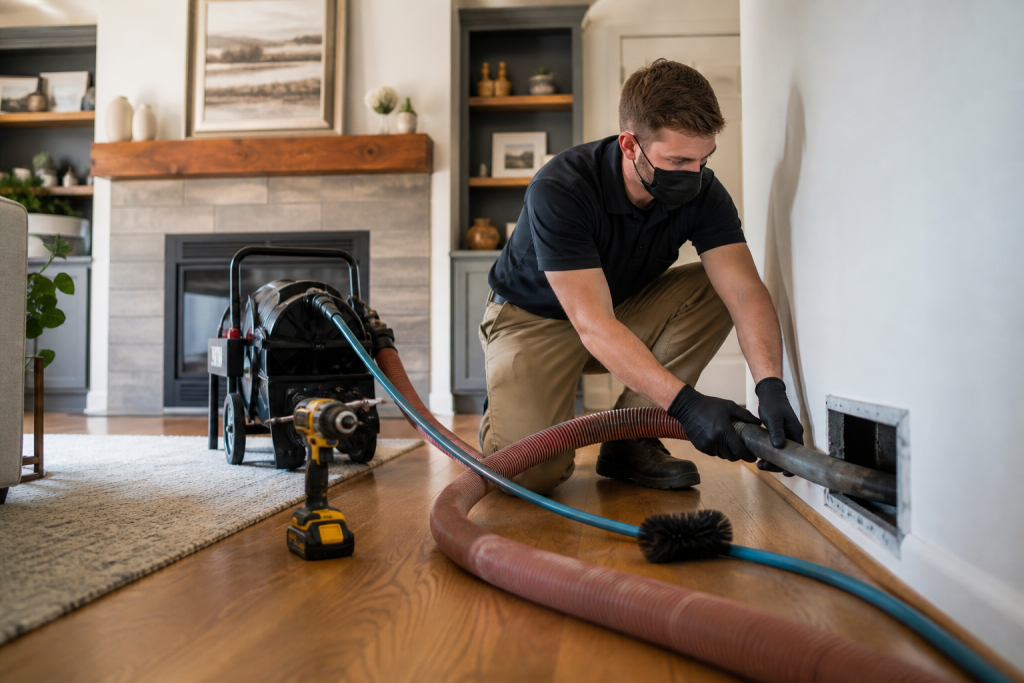
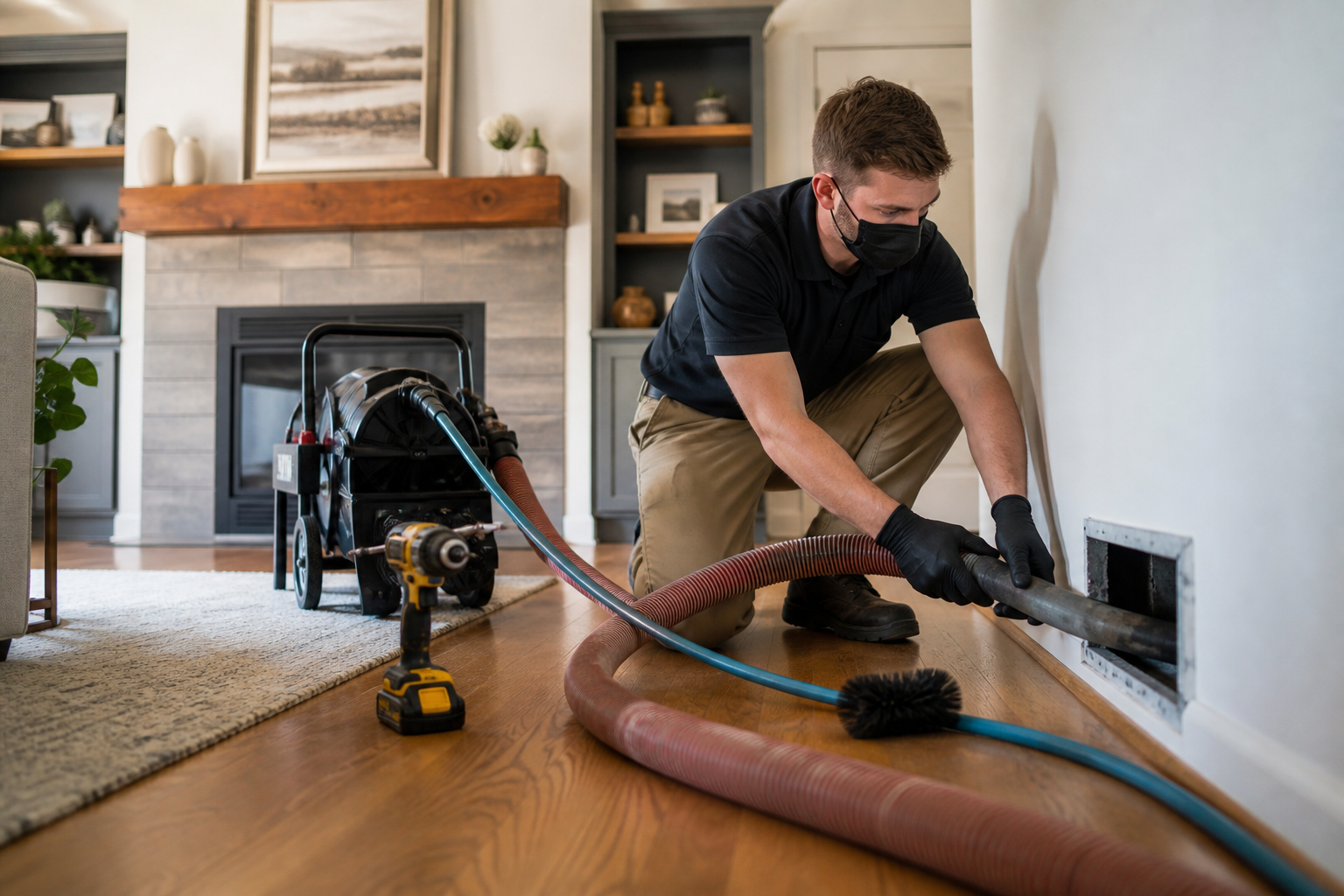
Here’s the mechanical reality: these machines draw air through a sealed HEPA filter (99.97% efficiency at 0.3 microns) while creating negative pressure in the work zone. In duct cleaning, that “work zone” should be your entire duct network. The machine connects to your trunk line, seals the return, and pulls air one direction — out through the machine’s filtration stack rather than back into your living space.
What this means practically:
- Negative pressure prevents redistribution. Without it, agitating dust in a Charleston home built in 1952 sends legacy construction debris — plaster particulate, old insulation fibers, possibly lead-contaminated dust — straight into bedrooms through leaks in the duct envelope.
- HEPA capture is the endpoint. The machine doesn’t just move contamination; it traps it. Portable residential units often lack true HEPA final filters, exhausting fine particulate back through the motor housing.
- CFM matching matters. A PRED750 moves 750 cubic feet per minute. Your Charleston home’s HVAC system might move 1,200–1,600 CFM. One undersized machine on a large system can’t maintain negative pressure during agitation — it’s like trying to drain a bathtub with a drinking straw.
We’ve pulled jobs in the East End where a previous “cleaning” left visible dust lines on supply registers because the contractor ran a brush without negative containment. The equipment brand was correct. The physics were wrong.
How to Tell If a Technician Is Using Abatement Technologies Correctly
Charleston homeowners rarely get to watch their duct cleaning in progress. But you can verify proper protocol in about 60 seconds of observation. Here’s what correct setup looks like with Abatement Technologies negative-air equipment:
- Access panel creation, not register removal. The machine needs a sealed connection to your trunk line, typically through a 6–8 inch access cut. If a crew is working only through floor registers with a portable unit, they’re not running negative pressure through the system.
- Return air isolation. The return side gets sealed or separately filtered. If your return grille is pulling normally during “cleaning,” negative pressure isn’t isolated to the supply side.
- Visible HEPA stack. Abatement Technologies machines have a distinctive cylindrical HEPA housing. Ask to see it. Ask when the HEPA was last changed — not the pre-filter, the actual HEPA. In our experience with Charleston’s pollen-heavy springs and humid summers, these load fast.
- Agitation before extraction. The negative-air machine runs continuously while rotary brushes or air whips dislodge debris. Sequence matters: agitate, contain, extract. Not extract, then agitate, then hope.
We walked a job in South Hills last month where the homeowner’s previous cleaner had run a Rotobrush through supplies while a portable vacuum sat in the basement — not connected, just nearby. The Rotobrush is excellent agitation equipment. Without negative containment, it’s a dust distribution system.
Why HEPA Filtration Matters Specifically in Charleston Homes
Charleston’s housing stock skews older than national averages. Kanawha County has significant pre-1978 construction, and many neighborhoods — North Charleston, the East End, parts of Kanawha City — have homes with original ductwork or decades of layered renovations. When you disturb debris in these systems, you’re not dealing with ordinary household dust.
We’ve found:
- Legacy cellulose insulation in ducts from mid-century retrofits, breaking down into respirable fibers
- Plaster and lath particulate from wall penetrations during HVAC additions
- Previous rodent activity in crawlspace trunk lines, with dried biological material that becomes airborne during brush cleaning
- Mixed-era debris from multiple HVAC replacements where old duct sections weren’t fully cleared
Standard pleated filters or non-HEPA portable vacuums exhaust particles in the 1–5 micron range — the respirable fraction that penetrates deep lung tissue. Abatement Technologies’ HEPA certification (IEST-RP-CC001 compliant on newer units) captures these. In Charleston’s older homes, that specification isn’t marketing. It’s a health-relevant engineering standard.
Our Air Duct Cleaning in Charleston service specifically protocols for this housing stock. Ronald inspects every system before equipment selection — we’ve passed on using negative-air machines on small, isolated duct sections where containment isn’t the primary risk, and we’ve added supplemental HEPA air scrubbers in post-remediation jobs where total particle load demanded it.
Questions to Ask Any Contractor Who Drops the Abatement Technologies Name
Equipment name-dropping is common in Charleston’s competitive home services market. These questions separate technicians who understand the equipment from those who read a brochure:
- “Which model do you run, and what’s its rated CFM?” If they can’t answer, they didn’t spec the equipment. We run Nikro and Rotobrush systems alongside Abatement Technologies units — the specific application determines the tool.
- “How do you verify negative pressure during the job?” Look for mention of manometer readings, smoke pencil testing, or at minimum visual confirmation of suction at all registers. Vague answers mean no verification.
- “When did you last replace the HEPA, and can I see the replacement log?” Legitimate contractors track this. A loaded HEPA is worse than no HEPA — it strains the motor and can breach the filter media.
- “Do you clean returns and supplies, or just one side?” Full-system cleaning requires more than one access point and often multiple machine configurations. Single-access “cleaning” is surface-level at best.
Over 730 homeowners have reviewed our work — see what they found. The pattern in feedback we value most: customers who asked technical questions beforehand and recognized the difference in our answers.
Abatement Technologies vs. Portable Residential Units: What Actually Gets Removed
This comparison matters because Charleston homeowners increasingly see “duct cleaning” offered by carpet cleaners, handymen, and franchise operations with wildly different equipment tiers.
| Equipment Type | Typical Suction | Filtration Level | Containment Capability | What Gets Left Behind |
|---|---|---|---|---|
| Abatement Technologies PRED series | 750–1,200 CFM | True HEPA (99.97% @ 0.3µ) | Full-system negative pressure | Minimal — sealed extraction path |
| Mid-grade portable (Nikro, etc.) | 200–400 CFM | HEPA or near-HEPA | Point-source only | Debris beyond hose reach, fine particulate |
| Shop-vac style residential unit | 100–150 CFM | Standard pleated or bag | None — blows through motor | Most fine debris; redistributes respirable particles |
The critical distinction: suction power without containment and filtration redistributes. We’ve tested this. Run a shop-vac style unit in a Charleston basement duct, and particle counters upstairs often spike. The machine moved debris, not to the canister, but through the system.
Our HVAC Cleaning in Charleston service uses equipment matching — Rotobrush for light residential maintenance, Nikro and Abatement Technologies units where contamination load or system complexity demands full containment. From cleaning to sealing to sanitizing — one call covers it all, but only after we’ve determined what your specific system actually needs.
When to Call a Pro — and When Equipment Brand Isn’t the Deciding Factor
Call a professional when you can’t verify these three things yourself: system-wide negative pressure during agitation, true HEPA final filtration, and sealed access points that don’t damage ductwork. If a contractor won’t explain their setup in plain English, that’s the red flag — regardless of whether they own Abatement Technologies, Nikro, or a custom-built rig.
That said, some Charleston situations specifically warrant professional-grade equipment:
- Visible mold or musty odor from ducts — requires containment to prevent spore redistribution
- Post-renovation cleaning with drywall or insulation debris
- Homes with occupants having respiratory conditions where particle count matters
- Systems with significant buildup (more than 1/4 inch visible in register boots)
Related services in Charleston: if your system’s inefficiency might be leakage rather than contamination, our Nova Air Duct Cleaning West Virginia home page covers duct repair and sealing — sometimes the problem isn’t dirty ducts, it’s ducts that were never properly sealed in the first place.
The Bottom Line
Abatement Technologies builds legitimate equipment, but the brand on the machine matters less than the protocol around it. In Charleston’s older housing stock, proper negative-air containment with HEPA filtration isn’t premium service — it’s baseline competent service. The questions we’ve outlined let you verify whether a contractor understands their own tools.
Key takeaways:
- Negative pressure containment prevents redistribution of disturbed debris — suction alone doesn’t
- True HEPA filtration captures respirable particles that Charleston’s older homes often harbor
- Equipment model and CFM rating should be transparent; evasion suggests superficial knowledge
- Full-system cleaning requires multiple access points and return/supply isolation
- The technician’s judgment in equipment selection matters as much as the equipment itself
If you’re in Charleston and want a technician who selects equipment based on your system’s actual condition — not a standard kit dropped at every door — Nova Air Duct Cleaning West Virginia offers free estimates. Ronald handles your job personally — you’re not getting a subcontractor. Call (877) 361-9762 and we’ll walk through what your home specifically needs.
Frequently Asked Questions
Proper negative-air duct cleaning with professional HEPA equipment in Charleston typically runs $400–$800 for residential systems under 3,000 square feet, with larger homes or heavy contamination reaching $1,000–$1,400. The range reflects actual equipment runtime, access difficulty in older Charleston homes, and whether returns and supplies both need full cleaning. Call (877) 361-9762 for an exact quote — estimates are free.
Yes — check for sealed access panels (not just register cleaning), ask to see the HEPA filter housing, and verify the return was isolated during supply cleaning. A properly run job leaves visible evidence: sealed cuts in the trunk line, filter replacement logs, and no dust settling on surfaces post-cleaning. We document our setup with photos for Charleston customers who want verification.
Different applications, not better or worse. Abatement Technologies excels at negative-air containment for heavy contamination or mold-sensitive environments. Rotobrush provides superior mechanical agitation in light-to-moderate residential cleaning. Nikro offers strong mid-grade portability. We use all three brands — 14 years of focused air duct expertise means matching the tool to the job, not forcing one solution everywhere.
Every 3–5 years for typical occupancy, sooner if you have pets, recent renovations, or allergy-sensitive residents. Charleston’s humidity and pollen load accelerate buildup, and older homes with original ductwork often need initial cleaning followed by more frequent maintenance. If it’s been over 5 years or you can’t remember your last service, inspection is warranted — call (877) 361-9762 and we’ll assess whether cleaning or sealing is your priority.
Written by Ronald Sanchez, Owner & Lead Technician at Nova Air Duct Cleaning West Virginia, serving Charleston since 2012.
Need Air Duct Cleaning Help?
Call Nova Air Duct Cleaning West Virginia — licensed & insured, here with fast after-hours help in West Virginia.
(877) 361-9762